What Frustrates Job Seekers Most? HERO’s Candidate Poll Results
A recruitment process tells candidates what an organisation is really like.
Job advertisements, careers pages and employer-brand messaging may describe a company as responsive, collaborative and people-focused. However, candidates judge those claims against what actually happens after they apply.
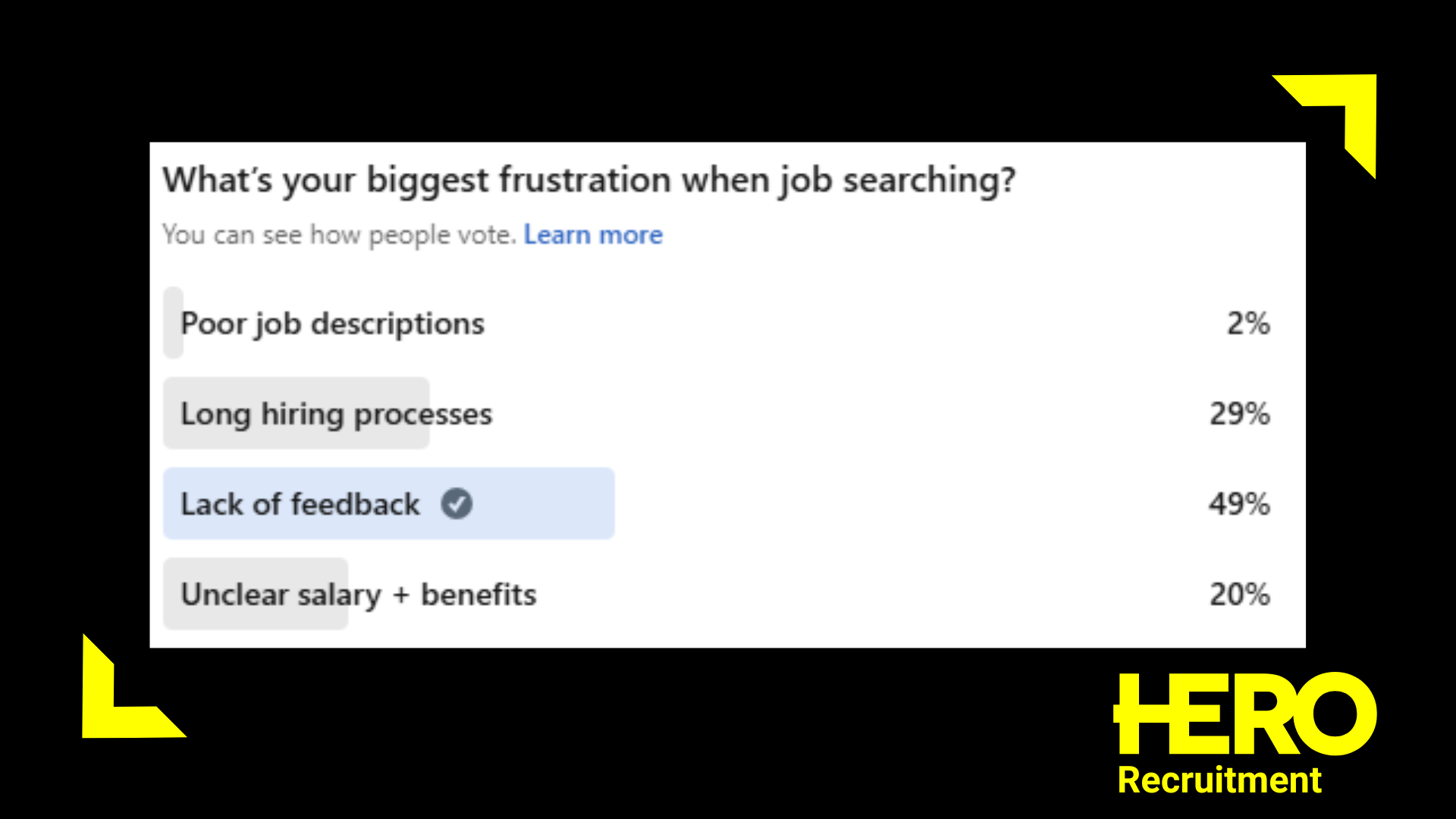
HERO asked job seekers:
What is your biggest frustration when searching for a job?
The results were:
- Lack of communication or feedback: 49%
- Long hiring processes: 29%
- Unclear salary and benefits: 20%
- Poor job descriptions: 2%
The message for employers is clear. Candidates do not expect to receive every job they apply for, but they do expect clarity, reasonable timelines and professional communication.
About HERO’s candidate poll
Poll dates:April 2026
Audience: STEM Candidates
Poll channel: LinkedIn
Geographic scope: Ireland
These figures represent respondents to HERO’s poll and should not be presented as a nationally representative survey unless the sample size and methodology support that claim.
What Is the Biggest Frustration for Job Seekers?
lmost half of respondents selected a lack of communication or feedback as their greatest frustration.
This is more than dissatisfaction with receiving a rejection. Candidates become frustrated when they do not know whether a recruitment process is still active, when promised updates do not arrive or when an employer stops communicating after an interview.
From the employer’s perspective, the delay may be caused by internal approval, diary availability, a changing budget or competing priorities. From the candidate’s perspective, there is only silence.
That silence can communicate several unintended messages:
- The role is not genuinely approved.
- The hiring team does not know what it wants.
- Candidate time is not valued.
- Decisions are difficult to make internally.
- Communication within the organisation may be equally inconsistent.
The reality employers often miss is that a candidate does not experience recruitment as an internal process. They experience it as direct evidence of how the organisation operates.
Check out: Pay Transparency in Ireland
Lack of Communication and Feedback
Communication does not require employers to provide a personal response to every application immediately. It does require them to set realistic expectations and close the process properly.
Common candidate frustrations include:
- Receiving no acknowledgement after applying.
- Not knowing when shortlisting will be completed.
- Hearing nothing after an interview.
- Being given a decision date that repeatedly moves.
- Receiving an automated rejection after several interviews.
- Discovering through the removed job advertisement that the role has been filled.
- Never being told that recruitment has been paused or cancelled.
Candidates who have only submitted an application may reasonably receive an automated acknowledgement or rejection. Candidates who have completed an interview or assessment deserve more direct communication.
Useful feedback does not need to be lengthy. It should be specific, factual and connected to the requirements of the position.
For example:
The successful candidate demonstrated more direct experience leading validation activities within a regulated manufacturing environment.
That is more useful than:
We decided to proceed with another candidate who was a closer fit.
Long and Unclear Hiring Processes
Long hiring processes were the second-largest frustration in HERO’s poll, selected by 29% of respondents.
Candidates may need to take annual leave, arrange childcare, travel, prepare presentations and spend several hours researching the company before attending an interview. Each additional stage creates a real cost for the person involved.
A thorough recruitment process is not automatically a poor one. Specialist, regulated or leadership positions may require technical assessments, compliance checks and several decision-makers.
The problem is unnecessary repetition.
Warning signs include:
- Several interviews covering the same questions.
- Interviewers who appear unfamiliar with the position.
- Additional stages introduced without explanation.
- Long gaps caused by unavailable decision-makers.
- A vacancy being advertised before budget approval.
- No agreed deadline for making the final decision.
- Different interviewers assessing candidates against different criteria.
Ireland’s labour market became more selective in early 2026. Approximately 2.79 million people were employed in the first quarter, virtually unchanged year on year, while unemployment rose to 4.9%. More available applicants may reduce pressure on some employers, but it does not remove the need for a disciplined hiring process. CSO, 2026
The hidden cost of a slow process is not only losing the preferred candidate. It also consumes management time, delays business delivery and leaves critical work without an owner.
If you're planning your next hire check out: Salaries in Ireland and Contract Rates in Ireland
How Candidate Experience Affects Employer Brand
Employer brand is built through behaviour rather than marketing language.
Candidates notice:
- how quickly they hear back
- how clearly the process is explained
- whether expectations are managed properly
- whether interviews feel organised and respectful
- whether they receive closure
An organisation may describe itself as agile, but take six weeks to approve an offer. It may promote respect while repeatedly missing candidate update dates. It may claim to value transparency while refusing to disclose even an indicative salary.
Candidates are likely to believe the process over the slogan.
A poor experience can affect more than one vacancy. Candidates may decide not to apply again, discourage colleagues from applying or decline an offer because the recruitment process created doubts about the working environment.
The uncomfortable truth is that an employer with a weak process may conclude that there is a talent shortage when the real problem is that suitable candidates are withdrawing.
How Employers Can Improve the Recruitment Process
The best hiring experiences are not always the most elaborate. Usually, they are simply the most considered.
Good employers tend to:
- communicate clearly
- move with purpose
- respect the candidate’s time
- set realistic expectations
- close the loop properly
These are not just process improvements. They are reputation builders. If your hiring process is creating friction, it may also be affecting how your brand is perceived in the market. Talk to us at HERO about creating a candidate experience that reflects the standards of your business. Reach out to us on (091) 730 022 or email hello@hero.ie.
FAQs

Search Jobs
Match my CV
We take the hard work out of finding you a new job. Simply upload your CV (or call us) and we’ll get hunting for you!
Subscribe to The Shift for the latest STEM industry and career updates.

Join The Shift!
Get insider updates on the hottest industry trends, cutting-edge career advice, and exclusive talent insights. Stay ahead of the curve and keep your finger on the pulse of Ireland’s STEM talent trends. Exciting content coming your way soon!